
 Search
Episode #129
Special Edition with Michael Kitces, Part 2
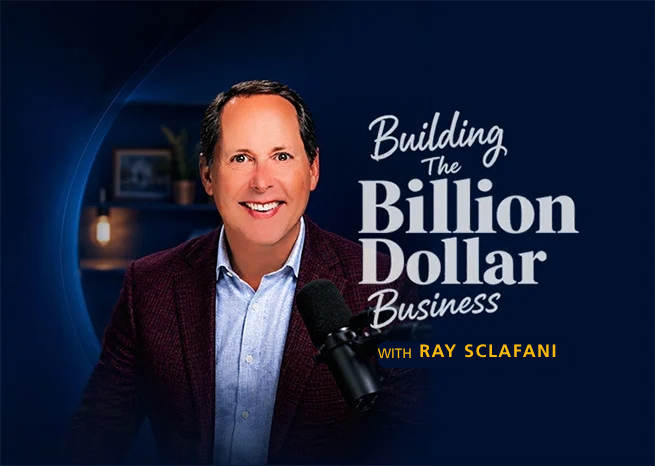
Building the Billion Dollar Business with RAY SCLAFANI
EPISODES
EMPOWERMENT
INSIGHTS
Executive Summary
Inside the Forces Reshaping Advisory Firms
In this special edition of Building the Billion Dollar Business, Ray Sclafani, Founder and CEO of ClientWise, welcomes back Michael Kitces for a wide-ranging second conversation about the forces reshaping advisory firms. Together they look at where AI is creating real capacity, why staff leverage is still the strongest predictor of advisor productivity, and how rising expectations are changing what it takes to enter the profession. Michael also explains the economics behind Vanguard’s acquisition of Altruist and shares new research on the marketing strategies driving client growth today. For firm leaders focused on enterprise value, the message is encouraging. Firms that invest in team design, deeper client engagement, and disciplined growth strategy are well positioned for the opportunity ahead.
Key Takeaways
The CRM will remain the hub of the advisory firm. Michael Kitces expects AI to show up inside the systems advisors already use, so firms don’t end up with yet another place to log in.
AI time savings are real but modest. About 200 hours a year is roughly 10% of a working year, which works out to two or three more client meetings a week. Most advisors spend that time deepening existing relationships.
Staff leverage still predicts productivity more than technology spend. Kitces Research data shows this has held for thirty years of technology change. As AI automates the bottom of the task list, there is always a new lowest-value task to delegate.
The entry-level bar is rising. Associate roles are shifting from data entry and note-taking to reviewing AI output and shaping planning recommendations. That makes CFP coursework and planning competency more valuable from day one.
Clients who check advice with AI are engaged clients. When clients come back with ChatGPT questions, they are trying to understand and buy in to the plan. That leads to deeper conversations and better follow-through.
In-person marketing is outperforming digital. Client acquisition costs fell by about a third to $2,551 per new client as advisors cut failing strategies. Seminars supported by direct mail show the biggest gap between how many consumers use the channel and how many advisors use it.
Transcript
Ray Sclafani: All right, Michael Kitces, part two. Welcome back. We didn’t have enough time to get through everything we wanted to. Last time we talked about your business and entrepreneurship. But my favorite thing, which I get to enjoy every few weeks, is when you and I run around the industry, share ideas, and challenge each other. So we’re going to do that here for the next forty-five minutes or so. What do you say?
Michael Kitces: Fantastic. Shockingly, we filled all the time. I hope we don’t run out again.
Ray: We probably will, but I’m going to push a little bit. I know sometimes you get running, and I may just shut you down and say, okay, next segment.
Michael: I wish you luck, my friend. Let’s see how that goes.
Ray: Okay, let’s get into it. You’ve written Weekend Reading in some form every week for well over a decade. In fact, it’s the thing I look forward to on Friday afternoons when Kitces.com shows up. What’s the biggest shift you’ve seen in what advisors are reading now versus five years ago?
Michael: The biggest shift now versus five years ago. Well, first, I have to give credit where it’s due. Adam Van Dusen on our team actually leads Weekend Reading at this point. We did a very clean, successful handoff and trained him to write Kitces-style content, so everybody believes it is still me. I did write it for more than ten years, but I stopped a year or two ago, and Adam leads it now.
We track the numbers and details closely, and much of it stays largely the same. Articles about taxes and retirement still tend to be the biggest driver of everything we publish. Articles about the industry at large actually tend not to get much engagement. A few of us love keeping up on industry news and chatter and what this organization or membership group is doing, but not actually a lot of us.
The biggest shift we’ve seen is a growing willingness to engage with articles about what I’ll call all things scaling the business. How do I run a bigger, more professional business, firm, or enterprise? Historically, we were an industry of solos hanging their own shingle and doing their own thing, so there weren’t many conversations about scaling the enterprise.
Ray: It was more about efficiency. How do I get more done with a limited amount of time?
Michael: Correct, it was a lot of personal efficiency. Personal efficiency still draws pretty well, and we still put those articles into the roundups. But we see more hunger for content on growing and managing the organization. Hiring, organizational charts, when to hire. A lot of topics tied to staffing get more engagement than they used to.
We also continue to see growing hunger for marketing content. It’s still not huge, because a growing percentage of us now work as employee advisors, where we don’t do the marketing; the firm does. But interest in marketing content is growing, especially around how to scale marketing beyond me and my personal hustle as the founder.
Ray: Okay, great. Let’s get into the segment I think will be the heart of today’s conversation, AI and the advisor. There’s a stat from your research that AI vendors now quote, that a typical practice spends only about one-sixth of its time in client meetings. Anthropic launched Claude for Financial Advisors in mid-September with connectors to Schwab, Vanguard, BlackRock, Orion, Envestnet, Addepar, Wealthbox, and others, and cited your one-sixth stat in the announcement. Your team called it a potential major innovation for integration. Is a general-purpose AI model finally the thing that solves the advisor tech integration problem the industry has failed to solve for more than twenty years?
Michael: Well, that question is a little bit loaded. Does AI, or Claude connected to everything, solve advisor integration pain? At best, I’ll say the jury is still out, and I’ll admit I’m not entirely convinced. For most advisors, the whole problem is that we have to log in to so many software systems. “Here’s another one to log in to” usually doesn’t go over very well in this industry.
At least in version 1.0, and we’ll see how it evolves, Claude connects to a lot of systems but not all of them. Most of those connections are read-only, not write. I think that’s probably intentional. AI that can write anywhere in your systems and accidentally overwrite data creates a whole new level of potential problems for the business. Picture it: “My team didn’t realize what they were doing. Someone typed a quick sentence that said update this, the AI misinterpreted it, and we deleted 172 addresses from our CRM.” Limiting it to read-only at the start is a sensible guardrail.
But if all it does is read and not write, I still have to log in to every other system to do my actual work. That makes it an overlay interface, a central place to query all of my scattered systems. That’s maybe neat if I want to look something up, and some of us already do that in Copilot or elsewhere. But I don’t know that it solves the bigger integration problem. My problem isn’t that I wish I could log in to one place to ask questions about my client data. My problem is that I have to log in to multiple systems to get things done. I trade in one place and check balances in another. I get performance reports from one system, the planning information lives in another, and contact information and notes history are somewhere else. I don’t know that Claude necessarily solves that. It starts to feel like just another place to log in.
Even where we see uptake of AI tools now, it looks more like this: you can use Claude directly inside Slant, a new CRM that’s building very deep AI integrations. You don’t have to leave the system. You do your AI work inside the CRM, and it’s connected to all the other data systems. It’s not a new place to log in, because I reach it from somewhere I already log in. My gut says that’s more likely how this plays out, given how new technology has historically been adopted in our industry.
Ray: That leads me to the follow-up. OpenAI announced its own financial services package just days before Anthropic. Do the frontier labs become the new operating system for advisory firms? And what happens to the CRMs and planning software that wanted to be the hub?
Michael: At the end of the day, I think the CRM will continue to be the hub. It’s already becoming more of the hub. If you go all the way back, the hub for most of us was the RIA custodian or broker-dealer portal. That’s where we logged in for the investment and money work most of us do. Then the hub started shifting to portfolio management tools that handled performance reporting, trading, and the rest of the portfolio work, so we logged in to our BD or custodial platforms less. For the past several years, the hub has been moving toward the CRM, because that’s where the notes, activity, and tasks live, and it’s where workflows tend to start. Especially as businesses grow and scale, your first login tends to be wherever the tasks, activities, and workflows happen, because that’s what actually drives the business day to day.
Ray: The whole engine.
Michael: Frontier AI models aren’t trying to be CRM systems. They’re trying to be frontier AI models. That’s what they’re there for. There are certainly great uses for AI, especially when it works with the CRM. We see it in how note takers like Jump and Zocks layer on top of CRMs, and in how AI is being built into some CRM systems. Again, I’ll give Slant a shout-out, because they’re doing really interesting things with AI inside a CRM. The synergy is clearly there.
But I don’t need Claude or ChatGPT to be my new daily login for AI tasks. I want whatever software I’m already using to connect to those models, do the AI work, and bring the answer back into the interface I’m already in. I’m sure Claude and OpenAI will power a lot of AI functions inside software. I’m just not convinced they’ll be where we log in for everyday work. You can always log in directly for general work, like “I’m working on a marketing plan, be my marketing consultant and help me brainstorm.” But for business functions with tasks and workflows tied to client records and client data, I think that work is much more likely to live in CRM systems than in the AI platforms.
Ray: Interesting. In July, in your Advisor Tech column, you asked how many firms need to warehouse their own data to build agentic workflows. Does a connector model, where the data stays at the custodian, make the data warehouse push obsolete?
Michael: To me, this is a genuinely open question, because industry firms are trying to solve it both ways at once. Some players, like Dispatch, say you don’t need a data warehouse. They connect the data to all the different places, and AI is quite good at taking imperfectly formatted, unstructured data and turning it into what you need to move it from place to place, which was historically the problem. Other companies, like Milemarker, say they’ll stand up your own data warehouse. Many CRM and portfolio management systems are also saying, let us be your data warehouse. Everyone wants to supply the data warehouse and be the data rails all of this runs on.
We’re doing all of this because the saying now is that if you want AI to do AI things, it needs data. So apparently I have to put all my data in one place so the AI can do AI things, even though I’m not sure what those things are. I’ve heard they’re amazing, everything will be magical, and I won’t need employees anymore. It’s a strange circular logic. We’re obsessed with warehousing data to do AI work, but we’re not sure which AI work we’re going to do. And we’re not even sure the data needs to be in one place, because AI may be good enough at working across multiple sources that it doesn’t matter.
Broadly, the jury is still out for me. If I had to guess, a small subset of very large firms will stand up their own data warehouses, because they’re willing to make the investment and figure it out. The other 98% or so of firms will never do that. We’re not technologists, and we don’t know how to build data warehouses. It’s expensive, as in hundreds of thousands to millions of dollars.
Ray: And it’s risky. Cybersecurity.
Michael: Most of this will get solved either because standalone data warehouse providers emerge or, more realistically in my view, because we pour most of our data into CRM systems. Salesforce can essentially do most of this already, and some newer players like Slant are doing it too. CRMs will increasingly become data hubs. They’re already the system of record for most of our core functions. They’ll pull in more of the data and connect to the AI.
I don’t think we’re headed for a revolution where data warehouses power all the AI and all the old software disappears. I think CRMs will get dramatically upgraded: far more capable, built on underlying data models with AI layers, doing CRM work better than traditional CRMs because they’re AI-enabled. It’s like what happened when software moved from servers to the cloud. It got a lot better, but nobody walks around saying they have an amazing cloud-based CRM now. We just say we use a CRM. Being in the cloud and having APIs are a given.
Ray: It’s table stakes.
Michael: I think the same thing will happen with how data gets stored and how AI gets used. My bet is that the CRM continues to be the chassis.
Ray: Let’s talk about time savings and the return on all this tech. You’ve shared two data points I found really interesting. In your September 18 Weekend Reading, a Vanguard-sponsored survey of 549 advisors found that 72% wish they had more time for prospecting and deepening client relationships. Then on September 25, you published an AssetMark survey of 400 advisors. Among AI users, 54% save four or more hours a week, and 15% save eight or more. Surveys now say AI saves advisors about 200 hours a year, yet advisors still say they lack client time. Where is the saved time actually going?
Michael: A few things are worth thinking about here. First, 200 hours a year sounds impressive, but a typical working year is 2,000 hours. We’re talking about 10% of your time. So an advisor who used to spend 15 to 20% of their time in meetings could now spend about 25%. Broken down by week, that’s four hours, so maybe two or three more client meetings. Prep and follow-up go faster, but I still have to get up to speed before each meeting, and I still have to review the AI notes afterward before I hit send. So all that time savings might add two or three client meetings a week.
That’s not trivial. You and I have both worked with a lot of advisors, Ray. Show me an advisor who holds another hundred client meetings a year, and I’ll show you an advisor who’s more productive, has deeper relationships, and is doing better in their firm. But it isn’t a revolutionary change in meeting count. Then the question becomes what we do with those extra meetings. A few very growth-oriented advisors will spend the time at marketing and networking meetings. Most established advisors will call a few top clients they haven’t talked to as often as they’d like, just to check in. Every so often, one of those clients actually needs something, and I’ll spend an hour going down a rabbit hole trying to give them great service.
All of that is positive. But if you’re looking for a big jump in productivity and growth, it isn’t there. I made a couple more check-in calls. I maybe took one or two more meetings, mostly with existing clients, because real marketing takes more than one or two one-hour meetings squeezed in. That’s a lot more work. So I don’t see growth changing much. We don’t take on many more clients, because there aren’t many more meetings in play, and most of us instinctively go deeper with our existing top clients rather than add new ones.
Keep in mind, too, that the time-savings numbers at this stage are very skewed. Oversimplifying a little, there are two kinds of advisors: those who take voluminous notes and those who don’t. Heavy note takers spend four or more hours a week on notes, so they think AI note takers are amazing. Their note-taking time drops dramatically. But they’re only a subset. There’s another group, who shall not be named to their compliance departments, who aren’t great note takers. They don’t save much time on notes. In fact, if they now record every meeting and have to review the notes, it takes them more time. Averaged across all advisors, I’m not sure how much net time is actually saved. I’m sure there’s some, because note-taking really is time-consuming for those of us who do a lot of it, and those savings are real.
Ray: Parker Ence at Jump would argue with you about this. I know he would.
Michael: Yep, and much love to Parker and the Jump team, and to the Zocks team as well. To me, the time-savings numbers we’re hearing are probably best-case scenarios from the most note-intensive advisors, because many of the others aren’t using these tools yet. Jump’s growth has been remarkable. It’s the fastest-growing advisor tech company we’ve ever tracked, with close to 50,000 users in three years. But there are roughly 300,000 of us, according to Cerulli. That’s great news for those companies, because there’s a lot of room left to grow. But the first adopters are the people with the most pain.
So the heaviest note takers maybe take two or three more meetings a week. Some don’t even take that many, because they use the time for check-in calls instead. And most of that time goes to existing clients, not new ones. So you don’t necessarily see a big jump in capacity or growth. That’s before counting the advisors who now spend more time reviewing notes than they used to, which lowers their capacity a bit because they’re getting more thorough with their notes. I’d argue that’s still a good outcome. You should have good notes on file, for a lot of reasons. But adding notes review for someone who wasn’t doing a great job on notes in the first place isn’t a productivity gain.
Ray: I listen to Kitces & Carl regularly. Episode 190, back in May, was about the advisor talent shortage, and you asked whether AI solves it by eliminating the entry-level jobs that create future advisors. Where have you landed since May?
Michael: In the short term, I’m a little worried that some firms are gradually delaying when they hire associate advisors. That’s not a great sign for the talent pipeline in the long run. If we want experienced advisors in five to ten years, we need inexperienced advisors today who will spend those years gaining experience.
In the long term, I’m more optimistic. I don’t think this will make the talent shortage dramatically worse. Ray, I know you see this with the firms you coach. Take any advisor at the top of their game, using all the technology AI makes possible. There is still something at the bottom of their task list that they shouldn’t be doing and could delegate. Maybe the bar rises a little, because a few tasks you used to delegate are now automated by AI. That’s great. But then there’s something a little higher up that you never used to delegate, which is now your lowest-value task, and it still needs to be delegated.
Practice management research has shown a consistent theme over thirty years of technology change. Even in the 1990s, before the internet, when our software came on discs and ran on servers in a closet, one of the biggest predictors of advisor productivity was staff leverage. In other words, how many non-advisors were on the team for advisors to delegate to?
Today we’re building a new tool called Advisor Economics, which pulls in data from QuickBooks so advisors can benchmark themselves and track their KPIs. When we drill down into what drives productivity, it’s still staff leverage. In our current data, staff leverage matters more than technology spending or technology use. Maybe that will change in the future, and I can’t rule it out. But consider what the business looked like back then. We opened envelopes, pulled out statements, filed them in clients’ paper folders, and looked for checks, because heaven forbid you sat on one for twenty-four hours. That was the business. At one of my first firms, a woman’s full-time job was opening the mail, filing statements, and looking for checks. In her spare time, she greeted clients when they came in for meetings.
That job is long gone, yet staff leverage and the ability to delegate are still among the biggest predictors of productivity. So I don’t think AI makes entry-level jobs disappear. They’ll shift. My associate used to take the notes. Now my associate reviews the AI note taker’s output. A little less yellow pad, but notes are still a function I’m better off delegating than doing myself as the advisor. Given shifts like that, I think there will still be roles for associate advisors. We’ll just have to figure out what the new roles and tasks look like and how they evolve.
Ray: Then let me ask a follow-up. If paraplanner and associate roles shrink, what does the apprenticeship model look like for a twenty-four-year-old in 2030?
Michael: I don’t know that those roles shrink. I think the work shifts. Less taking notes and more reviewing the notes. Less data entry into planning software and more reviewing the recommendations and analysis, coming up with additional planning ideas, and explaining why they would or wouldn’t be appropriate. Paradoxically, the biggest change will probably be a higher bar for entry-level candidates, because new hires will need to do more specialized work from the start. The purely administrative tasks really are falling away.
So if I’m a twenty-four-year-old who wants that internship in a couple of years, I hope I’ve finished a financial planning undergrad degree and passed the CFP exam before I apply. A firm is going to say, I need someone who can work in the planning software and help build these plans. I don’t need you to enter data; my AI pulls it in through document extraction. I need you to help me figure out whether this is the right recommendation, and to use the AI tools and planning software to refine it for the client. That takes a solid knowledge base from day one.
Ray: And the good news is that we now have more than 300 universities around the country with CFP programs. That’s a real breakthrough for our industry.
Michael: Yes, and a shout-out to CFP Board. They’ve spent a lot of time over the past ten to fifteen years pushing financial planning into undergraduate programs. Financial planning education started out as adult-education certificate programs. A lot of us got our CFP after successfully selling insurance for five years. That has completely flipped. Thanks to CFP Board’s push to expand undergraduate and graduate programs, a lot of schools are now producing young people who arrive with that knowledge. They still have to learn everything else: how to talk to clients, how to communicate, how to apply what they know. Knowing tax, estate, investments, and insurance from the books is different from facing a client whose tax, insurance, estate, investment, and retirement issues are all tangled together.
Ray: And then there are human emotions in every decision.
Michael: And clients have the audacity not to be rational in every circumstance. So there’s still plenty of learning and training to do. Broadly, the minimum bar rises across the board. It rises for advisors, so the tasks they delegate are a little higher-level. That means new hires need to start a little higher to handle those tasks. It’s similar to what’s happened in society at large. There was a time when you could get a high school diploma and then a job. Then a college degree increasingly became the requirement. The same thing is happening in financial planning. The minimum bar for entry keeps rising. The good news is that the career pays very well in the long run, so for young people willing to make the investment, it works out really well.
Ray: I’ve been looking forward to asking you this one. Only 3% of investors say they’d replace their advisor with AI, but clients are already showing up with AI answers. “Did you just ChatGPT me?” You wrote a really good article on this. How should an advisor respond when a client challenges their advice using ChatGPT or Claude?
Michael: I see this as a very positive development, truly. And a shout-out to Dr. Meghaan Lurtz, who I think has explained this framing better than anyone. On the advisor’s side, many of us feel a little affronted at first. I worked hard on these recommendations, and you double-checked me against ChatGPT and came back with questions? But think about what’s actually happening. They came back. If they didn’t care what we had to say, they would have just done whatever ChatGPT said and moved on. Either they never would have hired us, or they would have run the plan through ChatGPT, followed its advice, and never come back. So why do they come back to have the conversation?
A lot of it comes down to an uncomfortable truth. Often when we deliver financial plans and recommendations, clients have no idea what we’re talking about. We get lost in jargon. They don’t follow everything we’re saying. They nod and smile, because that’s apparently what you do while the planner talks. It’s embarrassing for them, especially if they’re sitting next to their spouse and they’re supposed to be the money person. They don’t want to embarrass themselves by asking questions. So nobody asks. They go home and don’t implement anything.
Ray: And it’s hard to admit you don’t understand something when you’re talking to an expert.
Michael: Unfortunately, many of us have experienced that. I worked hard, built the plan, and made recommendations that were obviously good for the client, and for some reason the client didn’t implement them. They froze. Why? Maybe they didn’t understand what we gave them. Historically, what could they do about that? Not much. Maybe they’d search Google and read articles to get up to speed. But if they wanted to do that, they probably would have Googled their way to their own financial plan in the first place. They come to us because they don’t want to research and learn everything themselves. But they still need to buy in.
So what’s happening when a client runs the plan through ChatGPT and comes back with questions? As Dr. Lurtz puts it well, they’re trying to engage with the planning process and buy in to the recommendations. They’re bringing the questions they probably wanted to ask the first time but couldn’t, because they didn’t have the vocabulary. So which would you rather have: a client who nods and smiles without understanding, or a client who wants to understand the plan well enough to discuss it, and comes back to have that conversation? I want the second one. That client is more engaged in all the best ways.
Some clients don’t deliver their questions gracefully, so it can sound more confrontational than it should. And candidly, some of us don’t deliver the best advice, and ChatGPT may legitimately catch a flaw in our logic. Transitions like this push everyone to raise their game. Ultimately, what I see is clients becoming more engaged in the planning process and wanting deeper conversations, with a shortcut for getting up to speed quickly. It also gives them somewhere to ask questions that feels less judgmental than admitting to their advisor that they don’t understand. It’s a safe place to clarify what they want to ask before they come back to us.
One caveat, Ray: this is one of many reasons I’m not in the camp that says AI will make us super productive and we’ll all have two or three hundred clients. When clients get access to AI, they do more of their own research, ask more questions, and need another meeting. It takes more time. I’d still argue the result is a more engaged client and better recommendations, because we have a deeper, richer conversation about what matters to them. That makes them much more likely to implement the plan and get a better outcome. It’s all positive for the client and for planning outcomes. But it takes more time, not less. The deeper conversations AI prompts take longer. That’s why we’ve been raising this flag for years. If you’re counting on AI to get you to 200-plus clients per advisor, you may be surprised, because all of this is pushing us toward deeper planning, more complex work, and longer conversations. None of that is faster, and none of it means more clients.
Ray: Let’s shift gears and talk about the industry for a moment. I thought your take on the Vanguard and Altruist deal was contrarian. In your September 7 Weekend Reading, the headline was that Vanguard’s acquisition of Altruist is more about ETF costs than custodial tech. Walk us through the math. Why would Vanguard pay roughly $4 billion to avoid a revenue-sharing tax?
Michael: This gets into the odd economics of how RIA custodians actually make their money. Going back twenty or thirty years, to the early days of Schwab, Fidelity, TD, and a few others, custodians have made their money in a couple of main ways. The biggest, especially in recent years, is the net interest margin on cash. Technically they may earn it through money market fund expense ratios, but often they sweep the cash to an affiliated bank and earn the spread. And it’s enormous. Schwab is publicly traded, so you can look at its P&L: most of the company’s revenue comes from the spread on those small cash positions. From a P&L perspective, Schwab is a cash manager with a side hustle and eight trillion dollars in custody. The economics are wild.
Ray: And that’s widely known. It’s no surprise to anyone.
Michael: It’s well known. It’s why Schwab’s stock price is so sensitive to interest rate changes; rates directly affect its interest margin. After cash, the second major revenue source for most custodians has historically been revenue sharing from asset managers, mainly through mutual funds. There’s a whole structure around how mutual funds are held in accounts. Someone has to act as transfer agent and collect transfer agent fees. Many custodians built no-transaction-fee platforms funded by 12b-1 fees. Custodial platforms often collect anywhere from 10 to 25 basis points on every mutual fund in their ecosystem, and for the large players, that’s applied to hundreds of billions or trillions of dollars. It’s an immense amount of revenue, historically the second-biggest pillar after interest on cash.
The challenge is that over the past twenty years, ETFs have taken off, partly for their tradability, partly for their tax treatment, and partly because they’re cheaper. A big reason they’re cheaper is that they don’t carry the revenue-sharing layers that mutual funds pay back to custodial platforms. So ETFs have undercut mutual funds on price, and more assets have moved from mutual funds to ETFs. If you’re a custodian that earns money on mutual fund revenue sharing, that’s a serious structural problem. Money moves slowly, so each year it’s been a small single-digit percentage shift. But it’s been happening for about twenty years, and it has compounded into a significant problem.
So what’s the solution, now that it’s coming to a head? Fidelity and Schwab, as has been reported publicly, have been going to ETF providers about a new required revenue share, something like 10 to 15% of revenue that every ETF provider would have to pay. If they don’t, commission-free ETF trading goes away. The deal for the ETF provider is this: give us 15% of your revenue, or we’ll put a $100 ticket charge on all your ETFs, which essentially kills flows into them.
Ray: It sounds like ransom.
Michael: The custodial platform has to get paid somehow. They have real costs and need real revenue, and none of us seem to be paying for it directly. In the U.S., we don’t pay platform fees to custodians. That’s notable, because platform fees are common in almost every other financial advisor market in the world. The U.S. is somewhat unique in having no platform fees for RIA custodians, because they earn their money through these underlying arrangements. So custodians are in a bind. We’re all moving to lower-cost ETFs, and part of what makes them cheaper is that they don’t pay revenue sharing. Custodians are reaching a breaking point, saying they need revenue to run the business, and they’re going to asset managers for it.
For most asset managers, this is extremely unpleasant. Most industry observers expect the cost to get built into expense ratios and make funds more expensive. That’s literally one of the big reasons mutual funds cost more than ETFs in the first place. Then there’s Vanguard, which has, and apologies because I don’t know the exact figure right now, something like four trillion dollars in ETFs. Suppose someone tells you they’ll put a $100 ticket charge on all your ETFs unless you pay a 10 to 15% revenue share. When you do the math at that scale, at some point you realize you could buy your own custodian for what you’d pay in revenue sharing over the next ten to twenty years, and then you’d own it. That’s what Vanguard did.
Ray: And they have the cash to do it.
Michael: They have the financial wherewithal. Why pay revenue sharing to someone else’s platform when you can own a platform and have no reason to charge yourself? More importantly, think about the industry. Suppose I’m any other asset manager, and Schwab and Fidelity are squeezing me for platform fees but Altruist isn’t. How long before asset managers start telling advisors, “We know you’re happy with your custodian, but our funds would be cheaper on Altruist.” Or, “We’d love for you to move to Altruist, because we don’t want to pay Schwab and Fidelity, and otherwise they’ll hit you with $100 ticket charges. On Altruist, your clients’ funds stay cheaper.”
That creates an unusual downstream effect. If this really plays out, with Schwab and Fidelity continuing down this road and Altruist keeping a different path under Vanguard, suddenly every asset manager in the country is rooting for Altruist, purely out of self-interest. They don’t want to pay revenue sharing, raise their expense ratios, and fall further behind Vanguard, which already beats everyone on cost. Every asset manager now has an incentive to tell advisors it would be great if they moved their money to Altruist.
Ray: That’s a story to watch, and it may show up in our predictions for 2027. Let me keep going, because we only have a few minutes left. More than half of RIA client assets now sit in model portfolios. If investment management is increasingly outsourced to models, what will the advisor’s investment value proposition look like over the next three to five years?
Michael: The overall value proposition keeps shifting toward advice and planning, which has been happening structurally for a while. On the investment side, it plays out in a few ways, and we’re already seeing some of them. Some advisors compete on cost. They promise to shop hard and get costs down, so they use Vanguard, BlackRock, State Street, and similar providers. Other advisors argue against purely passive index portfolios and talk about factors. They aren’t active managers, but they tilt portfolios to capture factor premiums a pure index portfolio may miss. That’s why DFA and Avantis are still growing.
Other advisors will lead with taxes, promising a more tax-savvy approach. That starts with using ETFs for their tax benefits. Then it moves to direct indexing and granular tax-loss harvesting. Then there’s a broad wave of innovation in packaging tax-sensitive strategies right now: exchange funds, tax-aware long-short funds, box spread ETFs. The pitch is that anybody can manage your portfolio, but I can do it more tax-efficiently than anyone else.
There’s also a group of advisors who have always set themselves apart through access to new and unique investments. Historically, that meant getting you into a hot IPO, and a few firms connected to investment banking still have that access. What does that look like now? I think it’s the growth of alternatives. Anybody can buy you publicly traded investments, but I have access to interesting private ones. Even the name is great. They’re private, and that carries real cachet.
Ray: And alternatives have raised far more capital than any SaaS category, yet advisors today allocate only a sliver to alts.
Michael: I don’t need everything in alts to differentiate me. I just need more than zero. That’s the reality of any differentiation strategy. Plus, illiquidity, risk, and other factors mean you probably don’t want large portions of client money in alternatives or private investments.
Ray: So what do you think about the SEC preparing to widen retail access to private markets?
Michael: I do worry about widening access. Our markets have reached a strange place. We limit access to private investments because the information is poor, transparency is poor, and due diligence is nearly impossible for most people. So we offer them only to high-net-worth investors who can supposedly afford to lose the money and may be sophisticated enough to evaluate them. Now that has turned into everyone wanting access to what wealthy investors get. So there’s demand for private funds that are still extremely illiquid, with poor transparency and difficult due diligence. There will be blowups, because that happens almost every time large sums flow into opaque, illiquid investments.
Ray: Here’s the follow-up. What’s the advisor’s due diligence obligation when a client asks for private credit in their IRA?
Michael: You have to actually do the due diligence on the funds. You have to really analyze what you’re putting your client into. That means individual security or strategy analysis: how the fund is built, how the incentives work, and who earns what fees under which structures. It’s doable, but it’s hard, and I worry that some advisors aren’t doing enough diligence on these investments.
But to bring it full circle, part of me feels this problem starts with the SEC. Look at how many fewer companies go public than they used to, and how much longer companies stay private. To me, that traces fairly directly to a lot of SEC policy over the past ten to twenty years, done in the name of consumer protection and transparency. Much of Sarbanes-Oxley, for example, has made being a public company so burdensome that companies either don’t go public or stay private longer. Follow that to its logical conclusion. More companies stay private longer, so investors want access to private investments. Then they want to trade those investments to make them more liquid. And what do you get when you create liquidity for private investments in the broader market? Publicly traded securities. We’re reinventing publicly traded securities.
Ray: Public markets. I want to quickly highlight your research on how financial planners actually market their services. It’s a recent 123-page report with more than 100 charts, beautifully done, all in blue, because it has to be blue. We love blue at ClientWise too. It’s our color as well.
Michael: It’s all blue because it has to look like it came from us.
Ray: In your survey of more than 500 advisors, client acquisition costs fell by about a third since your prior study, to about $2,551 per new client. Why did it drop, and which tactics drove it?
Michael: It was a bit of a mixed bag. Advisors got a lot more efficient with their marketing. They needed fewer dollars to get the same growth. They didn’t grow more; they cut a lot of strategies that weren’t working. Growth rates were similar to our last study, but advisors dropped many strategies that were outright failures and had been driving up marketing costs.
Where did that show up? It’s fairly broad, but the general theme is a pullback from anything with heavy, time-consuming digital components. That’s striking, because all the buzz these days is about digital marketing. But our results show very clearly that marketing where you show up in person still outperforms marketing where you don’t. Seminars are doing better than webinars. In-person networking is doing better than social media networking. Almost anywhere there’s both a digital and an analog version of a strategy, the analog version tends to do better.
So much of the savings came from advisors scaling back digital marketing. Use of webinars, newsletters, blogging, and social media all went down, and podcast use dipped slightly. Most of what went up was in-person activity, like reaching out to centers of influence or building solicitor referral relationships. A few other groups stood out. One group doesn’t want to create digital content but would love for prospects to find them, so SEO, media appearances, and even paid advertising rose a bit. Another group is increasing cold outreach, including digital cold outreach through platforms like FINNY, WealthHawk, and Wealthfeed. Traditional cold calling showed up, and so did direct mail. You can’t get much more analog than direct mail, but the advisors using it are still getting results.
Ray: What’s old is new again. Fisher keeps sending me the same thing.
Michael: There’s a reason you keep getting it. A brilliant marketing friend told me years ago that when you pull one of those mailers out of your mailbox and think it’s junk, that it’s comically bad and nobody should send it, look again. If you keep getting it, it’s working. You may not be the target audience, because it clearly isn’t connecting with you. But direct mail is one of the most precisely measured channels, because it’s high-volume and outcomes can be tracked over time. For people who are skilled at direct mail, nothing in that envelope is an accident. If you keep getting the Fisher envelopes, it’s working.
Broadly, the single biggest gap we found between how many consumers find an advisor through a channel and how many advisors use that channel was seminar marketing filled through direct mail. A lot of consumers find their advisor through seminars, and very few advisors run seminars as a repeatable, scalable system.
Ray: I’d love to get into predictions for 2027, but I think we’re running out of time. Maybe we can get back together at the start of the year and play the prediction game for 2027.
Michael: New Year’s predictions for the new year. Yes.
Ray: Okay, last segment, a lightning round. Go really fast. One advisor tech tool every solo advisor should try in 2027.
Michael: If you haven’t tried an AI note taker yet, like Jump or Zocks, really go try one. Despite what I said earlier, it may take you a bit longer if you’re not a heavy note taker, because you have to review the output. If you’re not a heavy note taker, the value isn’t in getting the notes written. The value comes at your next review meeting, six to twelve months later, when it gives you a dossier of everything you discussed working on at the last client meeting.
Ray: Most overhyped trend in wealth management right now.
Michael: That AI is going to help us all serve 200-plus clients.
Ray: Most underrated planning strategy for 2027.
Michael: I have to come back to the really interesting tax-savvy tools we can now build: tax-loss harvesting with direct indexing, and tax-aware long-short strategies for clients who need to work through a large concentrated position. There’s a lot of money and opportunity flowing there right now.
Ray: Kitces & Carl Episode 182 said retirement age is peak advisor happiness. When does Michael Kitces retire?
Michael: I’m not going anywhere. I’m having fun. There’s so much left to do.
Ray: You and me both. Last question. One article from the past year every advisor should read.
Michael: That’s like picking your favorite child. That’s cruel. We recently did a deep dive into what actually drives referral outcomes, and it had some really interesting findings. A lot of firms say they used to grow much more through referrals, and now that they’ve added more advisors, they don’t. They assume the referral rate dropped because their advisors don’t ask often enough. What we found is that most of the decline isn’t because people stopped asking. The well runs dry. At some point, your clients have referred most of the people in their natural network. Whether a firm asks often or not, almost every firm settles at an organic growth rate from referrals of about 3 to 4% of clients a year, and asking more doesn’t meaningfully raise that number. What does give a slight lift is being really clear about who you serve and what your fees and minimums are, so clients know whom to refer.
But simply asking more doesn’t help. Most of the decline you’re feeling isn’t because your newer advisors don’t ask as well as you did. When you were asking, your clients were mostly new. Now your advisors work mostly with long-tenured clients, and that well has run dry. Their networks are tapped out. Until they move to The Villages and meet new people, they just don’t have anyone left in their circle to refer.
Ray: We’ll hit pause there and pick it up next time. I think everyone listening already knows Kitces.com. Make sure you’re reading Weekend Reading every Friday, and listen to the Financial Advisor Success and Kitces & Carl podcasts. The current Kitces Research Advisor Productivity Survey is also open, so be sure to participate. Where can people go to take it, Michael?
Michael: Just go to Kitces.com and click the login button. If you don’t have an account, you can create one, and it’s free if you’re just joining for the research studies. Once you’re in, there’s a Research link in the left sidebar where you can take the survey. If you complete it, you get early access to the study and a personal scorecard comparing your numbers to advisors at firms of your size and type. It’s always interesting to see how your productivity stacks up against your peers.
Ray: Awesome. Thanks so much for doing this. You’re a good friend, and I appreciate it.
Michael: Absolutely. My pleasure.
Questions Financial Advisory Firm Leaders and Team Members Often Ask
Will AI help financial advisors serve 200 or more clients? +
Michael Kitces calls this the most overhyped trend in wealth management. Surveys suggest AI saves about 200 hours a year, roughly 10% of a working year, which works out to two or three more meetings a week. And as clients use AI to research their plans, they ask more questions. That leads to deeper, more complex conversations that take more time, not less.
Will AI eliminate associate advisor and entry-level roles? +
Kitces expects these roles to change rather than disappear. Kitces Research data shows staff leverage still predicts advisor productivity more than technology spend does. As AI automates the most routine tasks, associates will move into reviewing AI output and shaping planning recommendations. That raises the entry bar and makes financial planning coursework and the CFP credential more valuable.
How should advisors respond when clients check their advice with ChatGPT? +
What marketing strategies are working best for financial advisors right now? +
Kitces Research found that client acquisition costs fell by about a third, to $2,551 per new client, mainly because advisors cut strategies that weren’t working. In-person approaches are outperforming digital ones: seminars beat webinars, and in-person networking beats social media. The biggest untapped opportunity is seminar marketing supported by direct mail and run as a repeatable system.
Build the Team That Turns New Capacity Into Growth
Michael Kitces’ research points to a clear truth: staff leverage, role clarity, and deeper client engagement still drive the most productive firms. ClientWise coaches partner with advisory leaders to design the team structures, delegation habits, and growth strategies that turn new technology into lasting enterprise value.
Together, we’ll design your firm’s next stage.